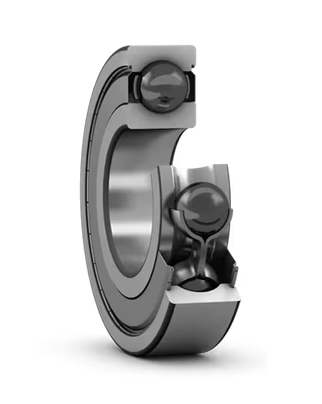
Cylindrical roller thrust bearing

4 product code

Cylindrical roller thrust bearing

Cylindrical roller thrust bearings is a bearing family for rotating machinery. Select the design according to load, speed, alignment and mounting requirements.

Loading product code list…

Selected code

81112 TN

Bore diameter - d60 mm
Outside diameter - D85 mm
Height - H17 mm
Mass0.27 kg

LDT will confirm price, stock and delivery time when the request is received.

Detailed technical content

Designed for high axial loads

Cylindrical roller thrust bearings are designed to accommodate high axial loads and shock loads while providing high rigidity and requiring little axial space. Unlike spherical roller thrust bearings, they have no self-aligning function and are not designed to carry radial loads.

The construction normally consists of a shaft washer, housing washer and separable roller-and-cage assembly. This allows the components to be mounted individually and is convenient where the fitted surfaces have a complex arrangement.

Squareness and support-surface requirements

Because cylindrical roller thrust bearings do not compensate for misalignment, the support surfaces for the shaft and housing washers must be machined and aligned appropriately. Angular misalignment causes uneven load distribution along the roller length and can increase edge stress.

When selecting a designation, check axial load, speed, d/D/H dimensions, mounting accuracy and the lubrication arrangement. If the application has radial load or significant misalignment, another bearing is required to perform those functions.

FAQ

Frequently asked questions

Can a cylindrical roller thrust bearing carry radial load?

No. SKF specifies this design for axial load, and the bearing should not be subjected to radial load. A shaft system with radial load requires a separate suitable radial bearing.

How do cylindrical roller thrust bearings and spherical roller thrust bearings differ under misalignment?

A spherical roller thrust bearing is self-aligning, while a cylindrical roller thrust bearing is not. If the shaft or support surface may be angularly misaligned, this must be carefully evaluated before selecting the cylindrical roller design.

Why is support-surface perpendicularity important?

Cylindrical rollers require even load distribution across their raceways. Relative tilting between the shaft washer and housing washer can concentrate load at one roller end, increasing stress and reducing bearing-system durability.

Can separate washers and roller-and-cage assemblies be interchanged freely?

No. Although the separable construction simplifies mounting, all components must match the correct series, dimensions and manufacturer requirements. Compatibility must be confirmed in the catalogue before replacing an individual component.

News about Bearings