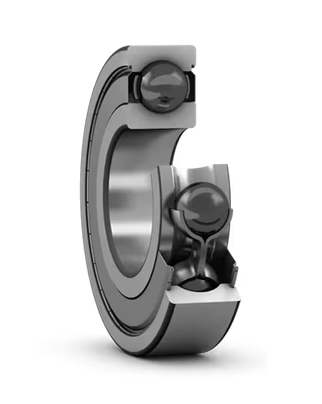
Double-row angular contact ball bearings

92 product code

Double-row angular contact ball bearings

Double-row angular contact ball bearings is a bearing family for rotating machinery. Select the design according to load, speed, alignment and mounting requirements.

Loading product code list…

Selected code

3200 A-2RS1TN9

Bore diameter - d10 mm
Outside diameter - D30 mm
Width - B14 mm

LDT will confirm price, stock and delivery time when the request is received.

Detailed technical content

Contact angle and axial load

Contact angle directly affects axial load capacity: a larger angle generally provides higher axial load capacity, while a speed-optimized design may use a smaller angle. Therefore, when selecting a designation, do not look only at dimensions and product series.

Single-row bearings and matched sets

Single-row bearings are often matched into sets when axial load must be carried in both directions or greater rigidity is needed. The three common arrangements are back-to-back, face-to-face and tandem. Back-to-back provides good rigidity and high resistance to tilting moments; face-to-face is less rigid but accommodates misalignment better; tandem is used when a high axial load must be divided in one direction.

Set clearance or preload is important for service life and stability. Excessive preload increases heat and stress, while excessive clearance can reduce rigidity and worsen the contact conditions.

Double-row type

In function, a double-row angular contact ball bearing is similar to a pair of single-row bearings arranged back-to-back, but occupies less axial space. When replacing one, still check the load, contact angle, clearance and sealing configuration of the exact designation.

FAQ

Frequently asked questions

Why are single-row angular contact ball bearings commonly paired?

A single-row bearing mainly carries axial load in one direction. Pairing two bearings allows the shaft arrangement to carry axial load in both directions or increases load capacity and rigidity. The pairing arrangement must suit the load direction and equipment requirements.

What is the difference between back-to-back and face-to-face arrangements?

A back-to-back arrangement has a wider effective spread and therefore generally provides greater rigidity and moment-load capacity. A face-to-face arrangement is less rigid but can accommodate misalignment better. Do not change the arrangement without checking the shaft-system design.

Can any two bearings with the same designation be assembled as a preloaded set?

Do not assume so. Applications requiring a defined preload or clearance should use products designed for universal matching or a properly matched set. Tolerance differences between individual bearings can produce a preload different from the intended value.

When should a double-row bearing be selected instead of two single-row bearings?

A double-row design is useful when axial load must be carried in both directions but axial installation space is limited. Two single-row bearings offer more flexibility in arrangement and preload. Selection depends on load, rigidity, speed and available space.

News about Bearings