Internal clearance in industrial bearings – understand it to choose correctly In industrial mechanics, bearings are important components that reduce friction and support shaft rotation. One technical factor with a direct effect on bearing performance and service life is internal clearance. What is internal clearance? What clearance classes are available, and how are they applied? Let us find out.
1. What is internal clearance?
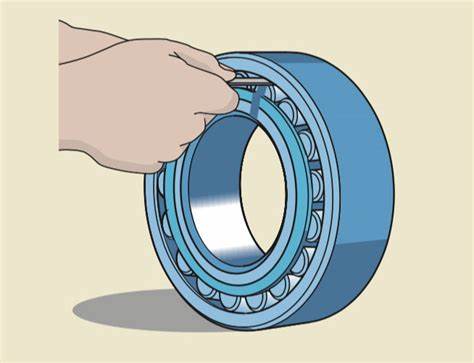
Bearing internal clearance is the total distance between the rolling elements (balls or rollers) and the raceways (inner and outer rings) when the bearing is unloaded and unmounted. There are two types:
- Radial clearance: the distance a roller or ball can move perpendicular to the shaft.
- Axial clearance: the distance it can move parallel to the shaft.
In practice, clearance often changes after a bearing is installed because of the interference fit and operating conditions (temperature, load, etc.).
2. Standard clearance classes
ISO and bearing manufacturers (such as SKF, NSK and FAG) have standardized internal-clearance classes so users can select according to their needs. Common classes include:
| Designation | Clearance level | Typical application |
| C1 | Very small | High precision, low vibration, light loads |
| C2 | Smaller than normal | Precision machinery, high speed |
| C0 or CN | Standard | General applications |
| C3 | Larger than standard | High-temperature operation or heavy loads |
| C4 | Larger than C3 | Harsh environments, high shaft expansion |
| C5 | Very large | Special applications with extremely high loads and temperatures |
Note: “C” stands for “Clearance”. A higher class is not automatically better—the key is choosing the correct class.
3. Why is the correct clearance class important?
Choosing the wrong internal clearance can lead to:
- Clearance too small: The bearing is over-tightened, increasing friction and heat and causing premature failure.
- Clearance too large: Increased vibration, reduced accuracy, excessive noise and shorter service life.
Selection should be based on rotational speed, load, temperature conditions, assembly method and shaft/bearing expansion during operation.
4. Advice when selecting bearings
- Consult the manufacturer’s catalogue to select the appropriate clearance class.
- If uncertain, use a CN (standard) class bearing—it suits most situations.
- For machinery operating at high temperature or under heavy loads, prioritize C3 or C4 bearings.
- When using a press fit, allow for the considerable reduction in clearance.
5. Conclusion
Understanding bearing internal-clearance classes is the key to improving equipment performance, minimizing failures and optimizing maintenance costs. Choosing the correct clearance class is not only a technical issue but also an important part of an effective maintenance and operating strategy in modern industry.
If you need detailed advice on the bearing type suitable for your application, please contact us for support from our specialist engineers.
LDT Vietnam is a top choice for customers purchasing genuine SKF products in Vietnam. LDT Vietnam Industrial Joint Stock Company is a leading supplier of SKF products and lubrication systems in Vietnam. The products supplied by LDT Vietnam have a particularly strong competitive position in the Vietnamese market.
- LDT Vietnam is the first and only authorized distributor in northern Vietnam appointed by SKF to distribute Lincoln & Alemite products and lubrication systems …
- With a business philosophy focused on the success of every partner, we believe that our partners’ success is our own success.
Dear customer, contact LDT using the information below for advice and special offers!
===================================
Address: No. 121-123 To Hieu Street, Nguyen Trai Ward, Ha Dong District, Hanoi, Vietnam
Business hotline: Mr. Toan: 0948.068.692
Fanpage:https://www.facebook.com/BoitroncongnghiepSKF?ref=embed_page