
Why should factories use automatic lubrication systems?
Canned and bottled foods and beverages are now common in convenience stores, with a growing variety of formats. Demand for packaged products in workplaces, schools, gyms and transport hubs continues to rise with global urbanization and population growth.
Higher consumption places more pressure on manufacturers and their machinery, making the beverage industry increasingly competitive. Plants often have little time for maintenance and may service equipment while it is still running. Machine failures significantly affect availability, and actual overall equipment effectiveness is often only about 60%. Filling machines are among the most important applications determining overall OEE in beverage production.
Manufacturers filling glass bottles, cans, pouches, tubes, PET containers and other packages with water, tea, smoothies or yogurt need accurate, flexible, hygienic and reliable equipment, even during continuous high-speed operation without planned maintenance stops. Automatic lubrication systems provide a new approach for beverage filling machines.
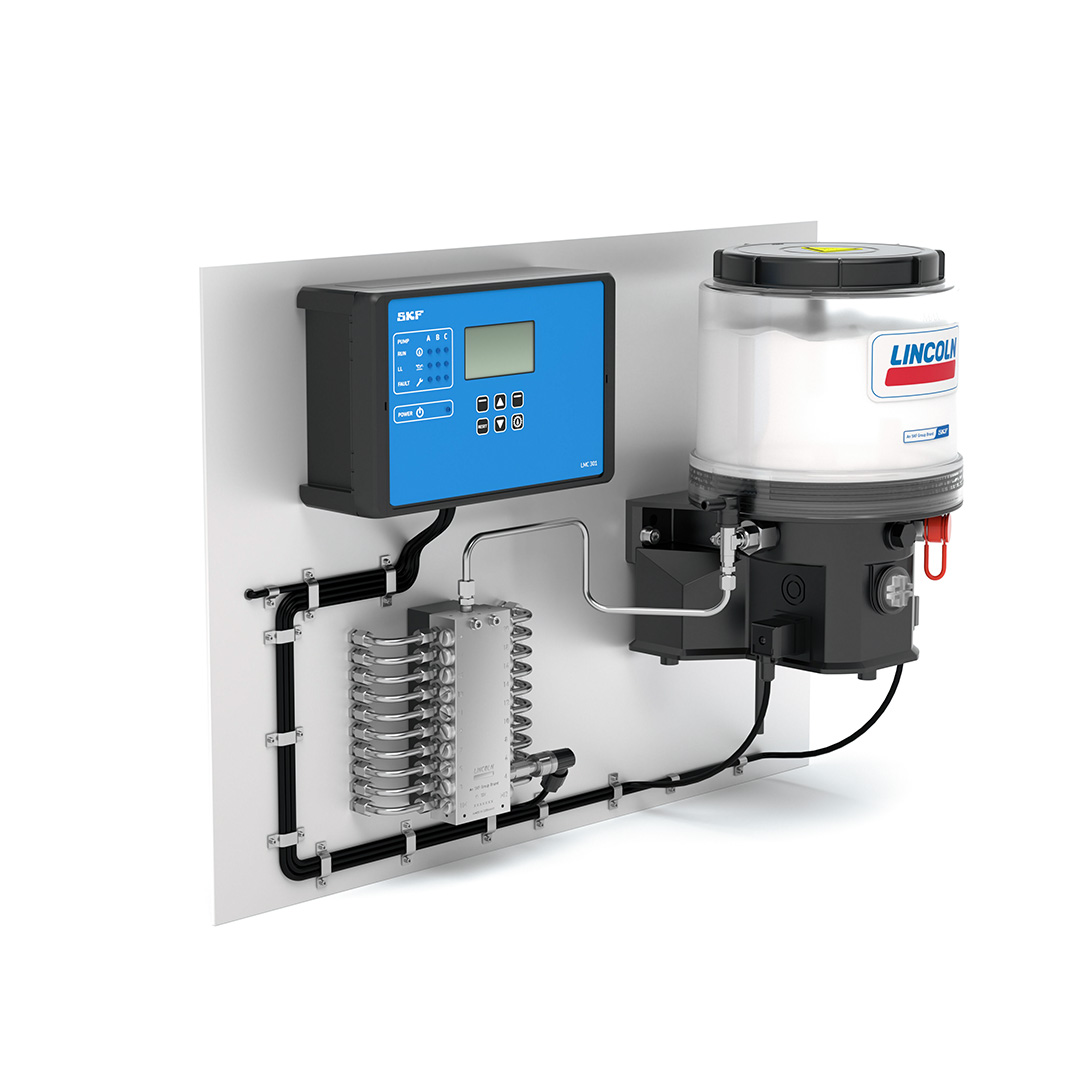
Progressive automatic lubrication systems are the most widely used type in the food and beverage industry. They suit small and medium-sized machines with dispersed lubrication points requiring different lubricant quantities.
SKF customers in the food and beverage sector have identified several lubrication challenges that affect filling-machine performance.
- Too little lubricant: Insufficient lubrication shortens the service life of machinery in general and bearings in particular. Causes include inaccurate metering and overlooked lubrication points, especially points that are difficult or impossible to access while the machine is operating.
- Too much lubricant: The greatest risk is costly contamination in the plant. An equally serious issue is grease or oil entering the water used to clean the machine, requiring the water-treatment process to comply with environmental regulations.
- Complexity: A filling machine may have up to 80 lubrication points, many located inside the machine and inaccessible during operation. Manual lubrication can create safety challenges, and different locations may require different lubrication techniques.
- Corrosion: Some lubrication devices are not designed for harsh beverage-industry conditions such as high humidity, which can corrode metering devices, grease fittings and pipework.
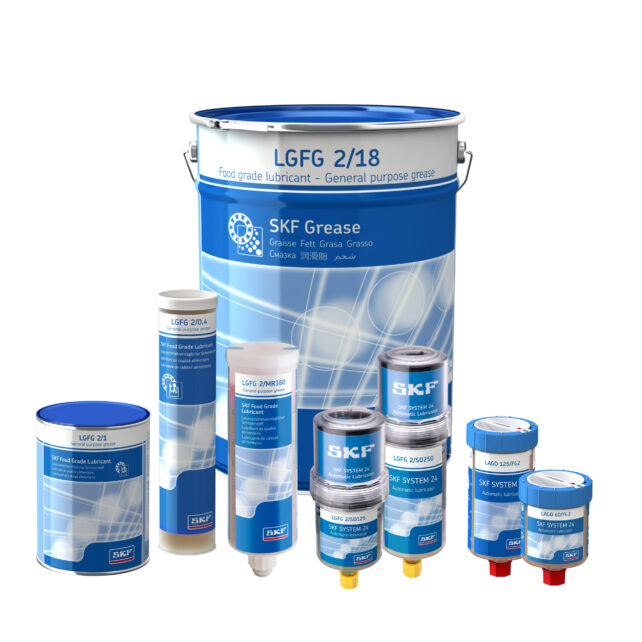
Lubrication is critical to filling-machine performance.
Centralized lubrication systems
Centralized automatic lubrication systems (ALS) can increase machine availability while reducing dependence on scarce labor. They supply the correct lubricant quantity at defined intervals, minimizing friction and wear while optimizing bearing and machine life.
Designed for individual machines or an entire plant, ALS delivers the correct and accurately metered lubricant to every required point. Supplying the right lubricant, in the right quantity, at the right time and at the right point eliminates human error, simplifies lubrication management, reduces lubricant consumption and improves overall bottling efficiency.
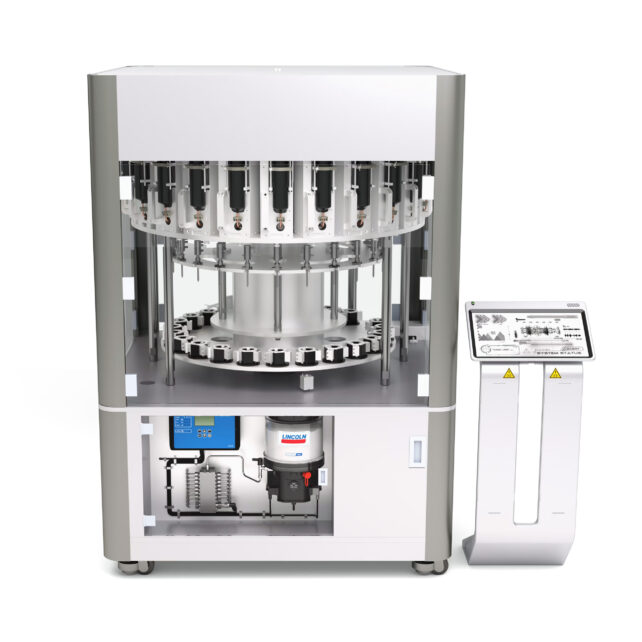
Centralized automatic lubrication systems (ALS) improve machine operating efficiency and reduce maintenance requirements.
Several key factors determine the correct solution for a particular filling machine:
- Size: Machine size determines the number of lubrication points and total lubricant consumption.
- Versatility: The selected system must deliver an accurate lubricant quantity to each point, with the amount adjustable for the machine component being lubricated.
- Technical specifications: The system must account for back pressure at lubrication points, operating-temperature range, lubricant selection, feed-pump power, and control and monitoring capability.
- Mechanisms requiring lubrication: These include bearings, gears, timing screws and other components.
- Plant environment: Stainless-steel components are usually essential for corrosion prevention. However, not every automatic lubrication system uses corrosion-resistant materials.
Types of automatic lubrication systems
- Single-line automatic lubrication system: A pump supplies lubricant to adjustable metering devices serving the lubrication points and dispensing precise quantities of grease or oil. A single-line system can service one machine or several separate machines. Sensors monitor system pressure and send signals to the controller at preset critical values. The controller activates lubrication automatically at defined intervals. A single-line system can serve up to 900 lubrication points over distances of up to 100 meters. Smaller systems use compact pump units with lubricant reservoirs, while larger systems use drum pumps. Installation is easier than some automatic grease systems, although the initial investment may be higher.
- Progressive automatic lubrication system: This is the most common system in the food and beverage industry. It suits small and medium-sized machines with dispersed lubrication points requiring different grease quantities. A progressive system consists of a pump connected to a primary metering device, whose outlets connect through pipes or high-pressure hoses to the filling machine lubrication points. The pump feeds the metering device, which divides the lubricant into predetermined quantities. Lubricant is then delivered to the points or to a secondary metering-device inlet so that more points can be served. Progressive systems can accurately meter lubricant to as many as 150 points over distances of approximately 15 meters.
Although an ALS may require a higher initial investment, its long-term benefits are greater. Labor costs fall significantly, while reduced downtime and longer component life generate further savings. Machines do not need to stop for lubrication; the system only needs monitoring and maintenance. Lubricating while bearings rotate also improves lubricant distribution. A continuous small flow of grease helps prevent contamination even when the machine operates in harsh environments.