Lubricating greases have been an integral part of our lives for centuries, playing a crucial role in the smooth operation of machinery and equipment. These semisolid materials, consisting of a base oil and thickener, possess unique properties that make them indispensable in applications ranging from rolling bearings to automotive components.
(Based on the article “Coarse-grained molecular dynamics modelling for lubricating grease simulation”)
History of lubricating grease
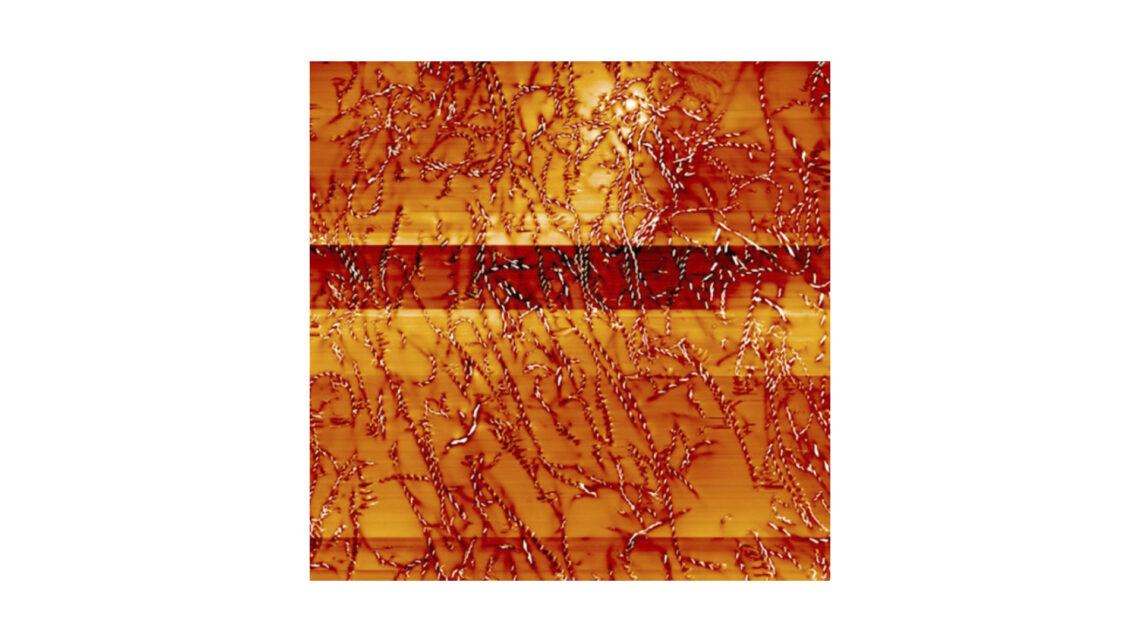
The history of lubricating grease dates back more than 3,000 years, when ancient civilizations used materials such as sheep and cattle fat as primitive axle grease. The modern era of grease development began with the discovery of oil in the United States, leading to the creation of multipurpose lubricating greases in the 1930s and 1940s. Today, lithium hydroxystearate-thickened grease, invented in 1942, accounts for more than 50% of the market, with rolling bearings among its most demanding applications. A magnified image of a typical lithium grease is shown in Fig. 1.
Research into lubricating grease
The outstanding performance of lubricating greases is largely due to their rheological properties, which determine how they flow and behave under different conditions. Grease exhibits a unique combination of solid-like and liquid-like properties, making it both resistant to leakage and highly mobile when subjected to shear.
Imagine a grease-filled rolling bearing at rest. In this state, the grease behaves like a solid and does not readily leak from the bearing. This is an important advantage over oil alone because it keeps the lubricant in place even in areas without applied shear, such as bearing shoulders, seals and housings.
When the bearing begins to rotate, however, the grease undergoes a remarkable transformation. Under shear, its apparent viscosity decreases and it flows more readily. This shear-thinning behaviour results from the grease microstructure, which consists of a network of fibres formed by thickener molecules.
During the initial churning phase of bearing operation, the grease is exposed to considerable shear energy, causing the fibres to align and temporarily disrupting the network. Its viscosity consequently falls substantially, making the grease highly mobile and allowing it to flow into critical areas of the bearing.
As the bearing continues to operate, the grease enters the bleeding phase, during which only slow flow and creep occur. Semi-static grease reservoirs formed in the unswept areas of the bearing gradually release base oil and replenish the thin lubricating films in the raceways. This replenishment is vital to extending bearing life because it maintains a continuous lubricant supply.
To understand the complex behaviour of lubricating grease, we have developed various models and simulations. One approach uses coarse-grained molecular dynamics to study interactions between grease components at the mesoscale. Figure 2 shows an example of the type of system modelled. Although only a two-dimensional image is shown, the simulation itself is three-dimensional.
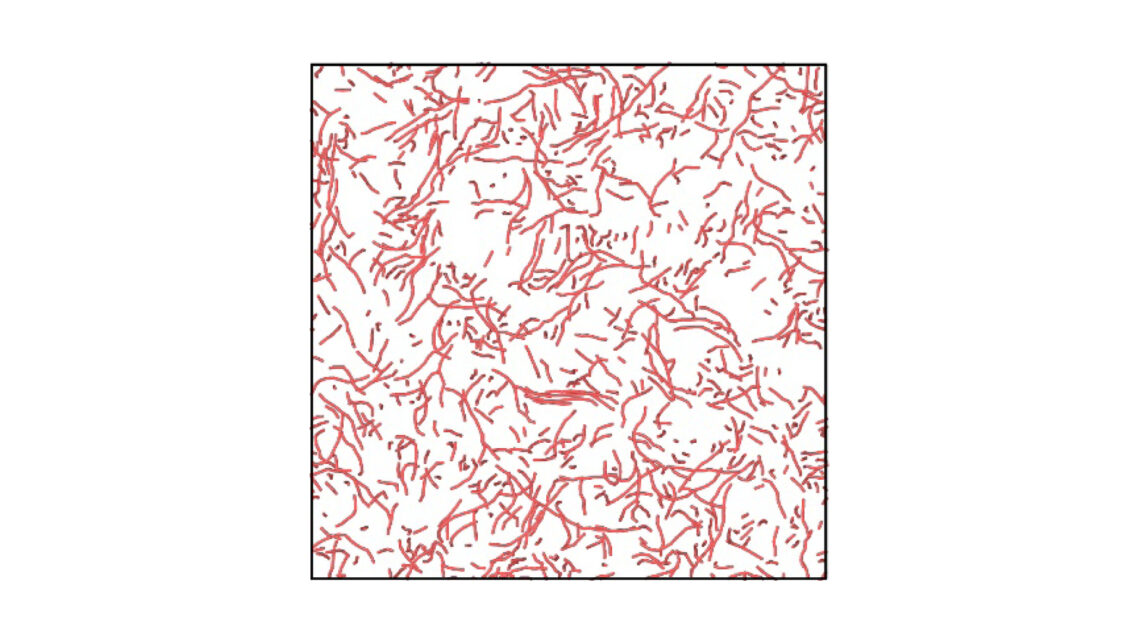
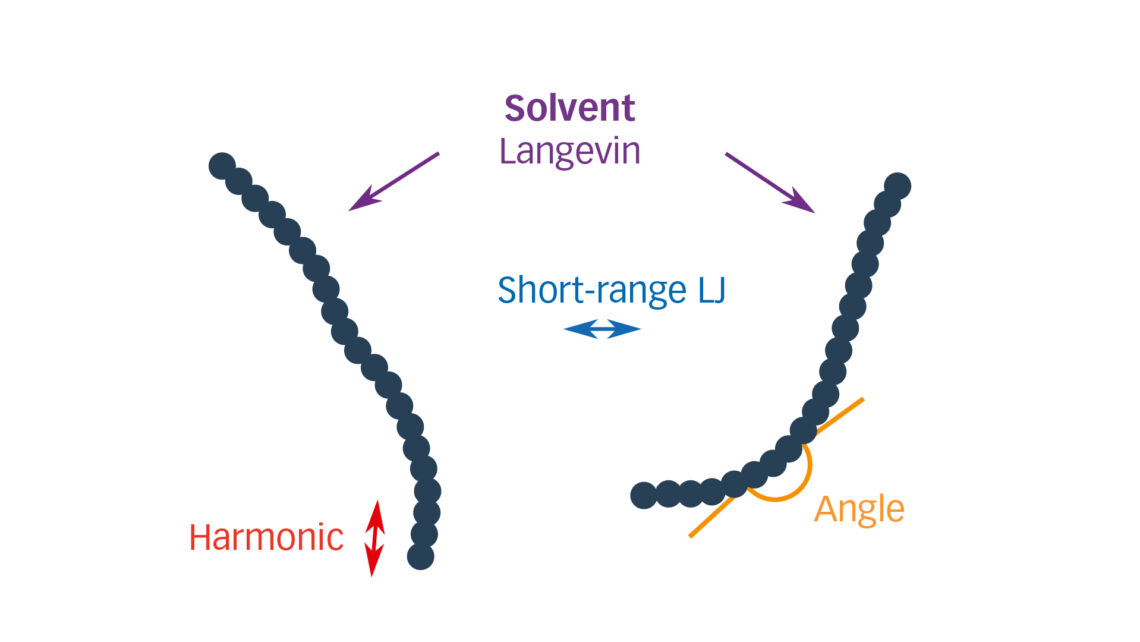
In this study, we created a computational model that simulates a suspension of interacting, semiflexible fibres representing the grease thickener. The fibres are immersed in an implicit solvent representing the base oil. By varying fibre length, stiffness and concentration, we can study how these parameters affect grease rheology. A visual representation of the fibre interactions used in our modelling framework is shown in Fig. 3.
The simulations revealed several interesting insights. Longer and stiffer fibres, as well as higher fibre concentrations, tended to align more closely with the applied shear direction. This alignment results from the fibres’ resistance to deformation, because stiffer and longer fibres are less likely to collapse or change direction under shear.
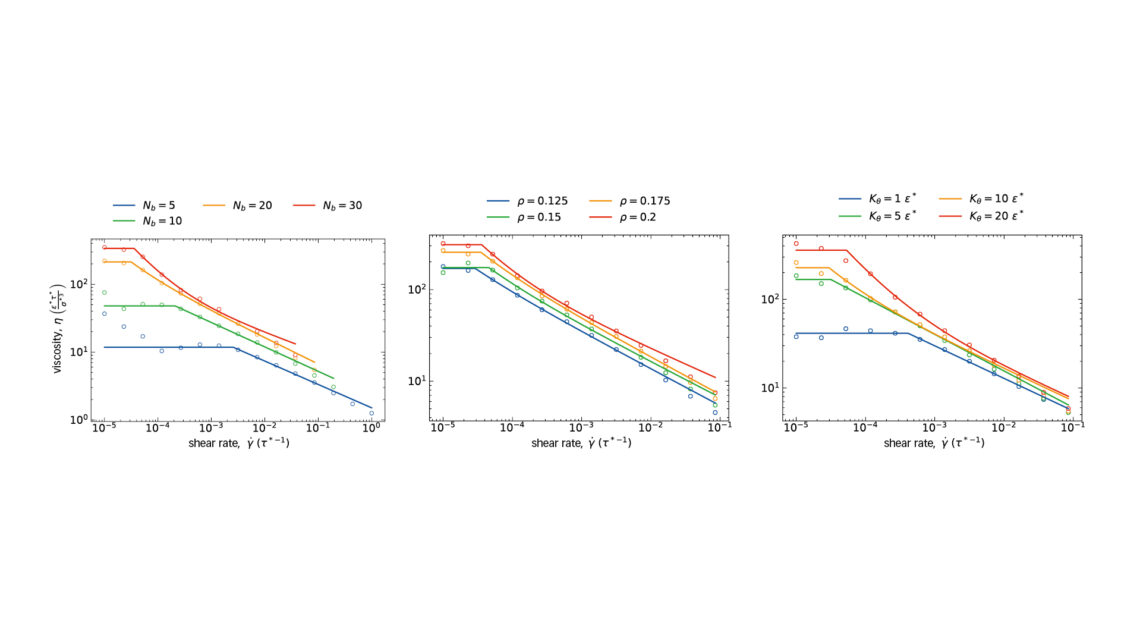
The simulations also showed that grease viscosity increases with fibre length, stiffness and concentration. This agrees with existing theoretical models, which predict that non-spherical particles such as grease fibres add resistance to flow and therefore increase viscosity (Fig. 4).
The model also enabled closer study of individual fibre behaviour. We found that shear deformation stretches the fibres and increases the tensile stress within them. Although the energy per bond remains constant at equilibrium, it rises with the length of a sheared fibre, making longer fibres more susceptible to breakage under higher stress.
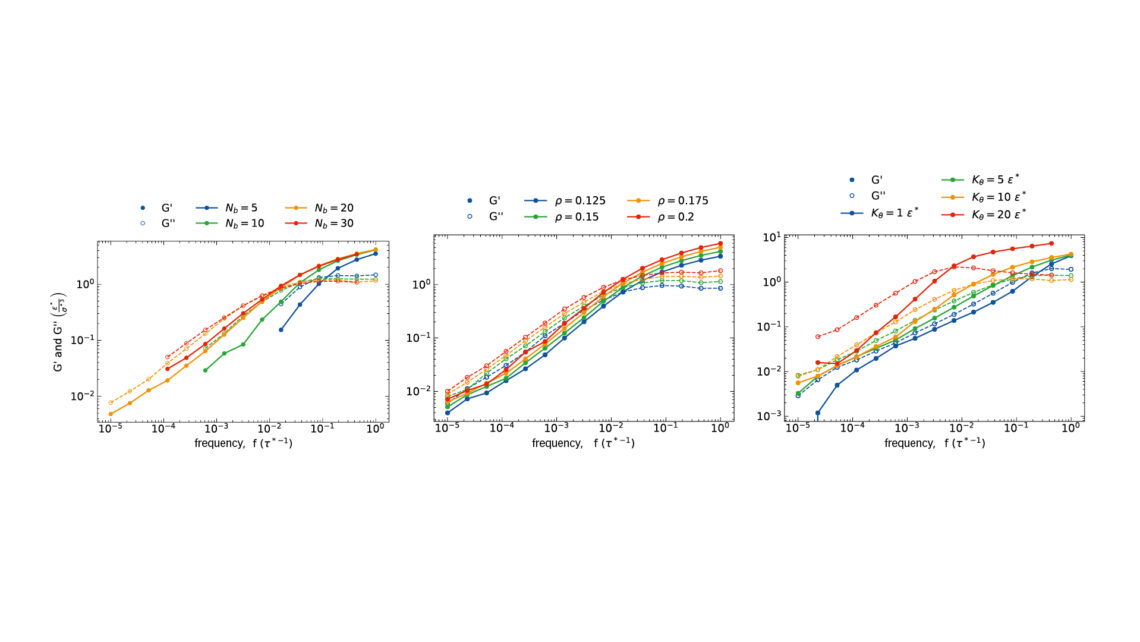
We also explored grease behaviour under oscillatory shear, simulating dynamic loading conditions encountered in many applications. The simulations showed that both the storage modulus, representing the elastic component, and the loss modulus, representing the viscous component, increase with fibre length, stiffness and concentration, as shown in Fig. 5. This agrees with experimental observations and provides valuable insight into grease viscoelasticity.
The comprehensive modelling framework developed in this study provides a powerful tool for exploring grease behaviour at time and length scales that are not easily accessible through experiments. Although the current findings are primarily qualitative, we expect this method to provide a valuable foundation for developing more advanced grease formulations and optimizing their performance in different applications.
Conclusion
In conclusion, lubricating greases are remarkable materials that have evolved over centuries, and their complex behaviour continues to fascinate researchers and engineers. By unravelling the mysteries of grease rheology through advanced computational modelling, we can deepen our understanding of these versatile lubricants and pave the way for even more efficient and reliable solutions across many industries.
Contact
LDT Vietnam Industrial Joint Stock Company
121-123 To Hieu Street, Nguyen Trai, Ha Dong, Hanoi.
Hotline: 081 685 6669 – 024 66880598
Email: info@ldtvn.com
Fanpage: LDT-SKF Lubrication Systems